
How Can Traditional Publishers Survive the Self-Publishing Tsunami?
Date Posted:
Category:
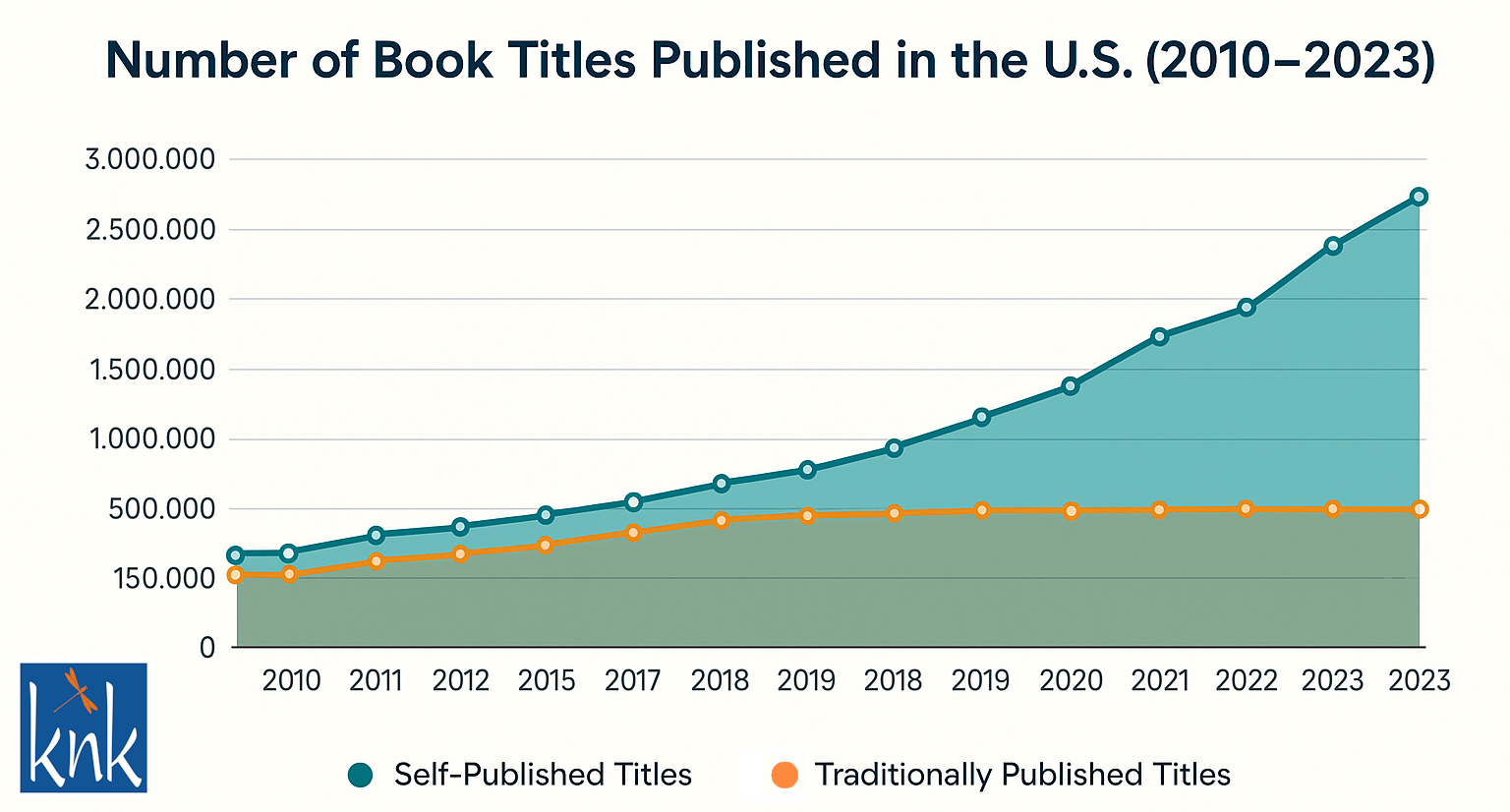
It’s a tidal wave. AAP reported sales of three quarters of a million books through traditional publishers in 2024, a period in which an amazing 2.6 million books were self-published.
This tsunami of self-published titles has surged from a base of merely 150,000 books in 2010, according to Bowker. By contrast, sales from traditional publishers have been flat for years, if you ignore the temporary growth during the pandemic. This article reviews the reasons for the surge and how publishers can still succeed.
Author Frustrations
The Author’s Guild reported in 2023 that most authors under the age of 45 planned to avoid traditional publishing and self-publish their next book. The trend was driven mostly by a younger demographic who were frustrated by:
- The loss of control over their work in traditional publishing
- The length of time it took from manuscript tendering to distribution
- The disheartening fact that only 1-2% of manuscripts submitted to traditional publishers led to book contracts
The so-called “slush pile” was high and wide, and authors felt they could do better. They were willing to forego the free services that traditional publishers offered in professional editing, marketing, production, and distribution. And they turned into content entrepreneurs, publishing experts, and authors, all rolled into one.
Self-Publishing Takes Off
The self-publishing movement accelerated in 2007 when Amazon announced Kindle Direct Publishing (KDP) and overnight, became not just a book seller, but a publisher – a big one. Self-published authors recognized that they had access to Amazon’s global marketplace, in addition to the opportunity for higher royalties than had been available from traditional publishers. 70% royalties from KDP is a juicy treat compared to 6-15% in the traditional route, despite the risks.
The obvious lure was that authors could control the publishing process, and if needed, take advantage of KDP’s limited editing, marketing, and production services. These authors relished the challenge, being already comfortable with social media and on-line interactions – the things that were necessary for building strong author-reader networks on which that business model thrives. Instagram, TikTok, and YouTube were part of their culture, and they used them to profound effect. Tellingly, these were the same skills that traditional publishers lacked.
What Next?
In 2025, the industry is at a critical inflection point. Traditional publishers still hold some big cards but are clearly under threat. In 2018, KDP accounted for over 90% of self-published books but now have lots of well-funded competitors. And for self-published authors, the market is oversaturated with new books and for all but the biggest authors, they still must distribute their book through multiple channels to have even a chance of success. So competition is fierce, and time is short for all the players involved. However, traditional publishers still have some strengths in this fight. They include:
- Industry resources and expertise
- Superior quality control – especially in the production processes
- Editorial power
- An established distribution network
- Marketing prowess and their own audiences (CRM)
However, from the author’s viewpoint, the weaknesses still abound – royalty problems, slowness to market, and lack of control.
Technology Provides the Solution
Royalty rates are certainly more attractive for self-published authors, but publishers can do more to support them with portals and services tailored to specific individual needs. An industry-standard royalty statement would help, and work is underway at BISG on that subject. Self-published authors receive royalty payments much more quickly than is typical with traditional publishers, who are constrained by adjustments for returns and other transactions that take time to process.
The smart application of technology can resolve many of these issues. Delays in returns data are a consequence of the “print-first-sell-later” business model that is employed in the trade. If publishers printed more books using Print-On-Demand (POD) systems, then there would be less need for contractual returns, resulting in swifter royalty payments, less waste, and more importantly, higher margins for publishers.
Authors are looking for a better experience all round. Publishers are experimenting with a hybrid approach, combining the best aspects of self and traditional publishing, giving authors more control while still providing some support in editorial, production, and marketing. These lower costs may allow publishers more leeway to offer higher royalties. Some publishers have introduced self-publishing imprints. All of them are now much more adept at using social media – “If you can’t beat them, join them!” Traditional publishers are also deploying more direct-to-consumer (D2C) selling, in the process garnering more essential data to understand reader behaviors and tailor the deliverables and customer journey accordingly. AI is sure to help. Savvy authors understand the value that publishers bring with their delivery networks, and marketing connections and lists. Traditional publishers must fight back with investments in technology to mine critical data that they lacked in the past to bolster author support and consumer sales. Let the battle continue!